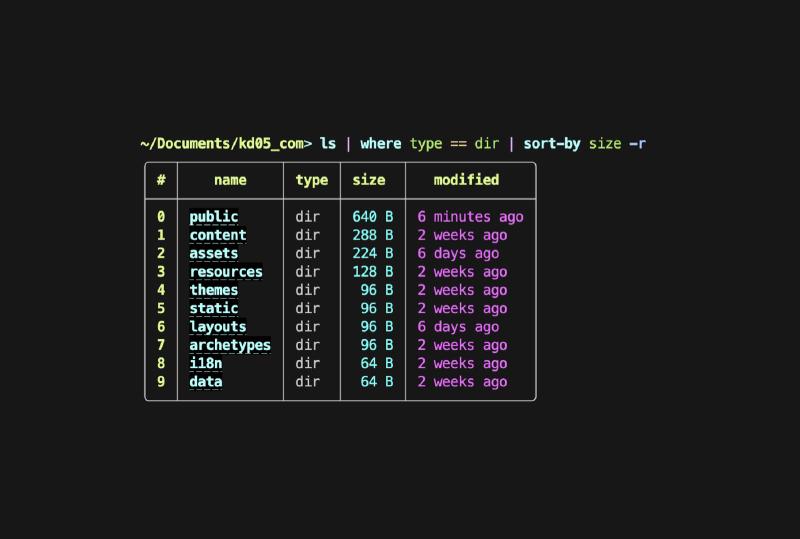
What is Nushell?
Nushell (commonly referred to as Nu) is a modern shell written in Rust. Its core objective is to blend the best aspects of traditional shells (like Bash and Zsh) with the power of modern programming languages, providing developers with a more structured, efficient, and user-friendly command-line environment.
Unlike traditional shells that treat everything as “plain text strings,” Nushell introduces the concept of structured data. This means that in Nushell, command output is no longer a text stream requiring complex regular expressions to parse; instead, it consists of data objects similar to database records or tables.
Core Advantages of Nushell
1. Structured Data and Tabular Presentation
When you execute a command like ls in Nushell, you are presented with a clean, organized table. File sizes, modification times, and permissions are stored in specific columns. This design allows users to filter, sort, and perform calculations directly on the output without relying on external tools like grep, awk, or sed for complex string manipulation.
2. Powerful Pipeline Operations
Nushell significantly enhances the capability of the pipe operator |. Since the data is structured, you can easily perform SQL-like queries. For example, a single line of code can find all files larger than 10MB in the current directory and sort them by size. This logical consistency dramatically lowers the barrier to writing complex scripts.
3. Built with Rust for Safety and Performance
Leveraging the Rust language, Nushell offers exceptional execution efficiency and memory safety. It features native cross-platform support, providing a consistent experience across Windows, macOS, and Linux—a critical factor for maintaining unified multi-platform development environments.
4. Superior Error Messaging and Interactive Experience
Nushell boasts a highly modern interface, including real-time syntax highlighting, advanced auto-completion, and incredibly readable error messages. When a script fails, Nushell points exactly to the location of the error and explains the cause in plain language, rather than returning cryptic error codes, significantly speeding up the debugging process.
Why is Nushell Attracting Developers?
The appeal of Nushell lies in how it redefines human-to-command-line interaction.
- For DevOps Engineers: Handling JSON, YAML, TOML, and CSV files becomes remarkably simple. Nushell treats these formats as first-class citizens, allowing them to be loaded and converted into structured tables for immediate manipulation.
- For General Developers: It provides a more intuitive, less error-prone scripting environment. You don’t need to master obscure legacy shell syntax; instead, you can accomplish complex tasks using concepts similar to functional programming.
- A Modern Philosophy: It functions more like a “programmable data processor” that lives in your terminal.
Learning Resources
Quick Start: Cookbook
Nushell is more than just a command interpreter; it represents a new direction in the evolution of command-line tools. By integrating structured data into the shell’s core, it solves the “text processing headaches” that have plagued developers for decades. If you are looking for a tool to boost your terminal productivity with a modern, cross-platform experience, Nushell is undoubtedly worth a try.